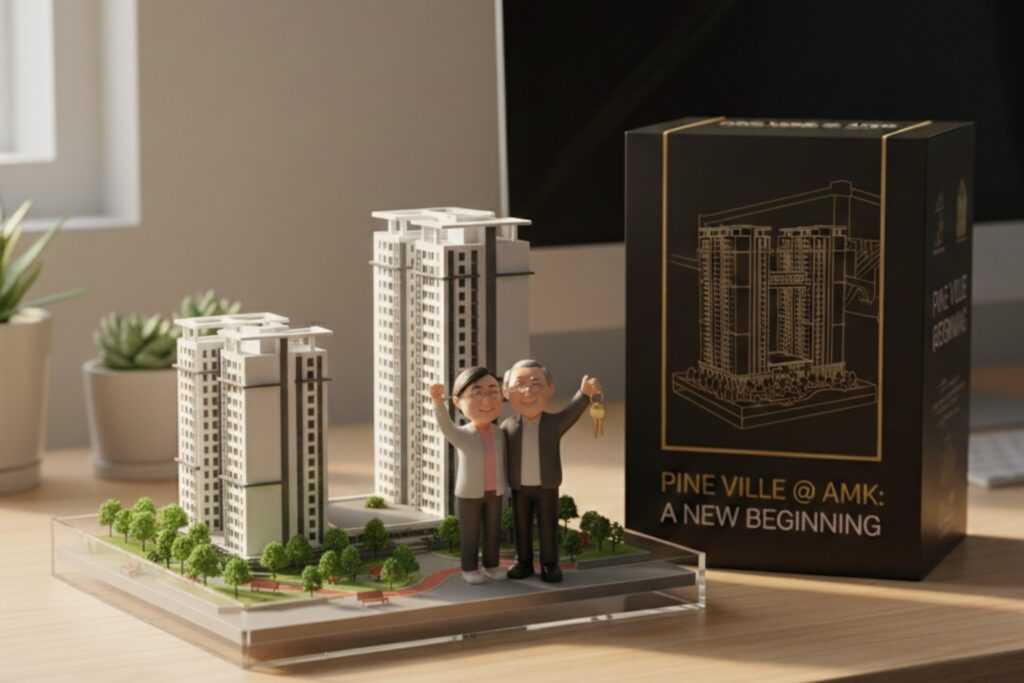
What If Blocks 562-565 AMK Were Selected for VERS Instead of SERS?
Key Facts
- Date of SERS Announcement: April 2022
- Affected Blocks: 562-565 Ang Mo Kio Avenue 3 (606 units)
- Remaining Lease at Announcement: 57 years
- Replacement Project: Pine Ville @ AMK
- VERS Eligibility Age: 70 years (would occur around 2049 for these blocks)
- Source: HDB SERS announcements, URA Master Plan 2025
For residents of Blocks 562-565 who relocated to Pine Ville @ AMK, the SERS announcement in April 2022 represented both disruption and opportunity. The question few considered at the time: what if these blocks had been selected for VERS (Voluntary Early Redevelopment Scheme) instead of the compulsory SERS programme?
Context: SERS vs VERS Framework
According to HDB’s policy framework, SERS is a compulsory acquisition programme where the government selects aging blocks with high redevelopment potential. VERS, announced as part of Singapore’s evolving public housing strategy, is a voluntary scheme requiring resident consensus for redevelopment.
SERS Process:
- Government-initiated and compulsory
- Market-rate compensation plus rehousing benefits
- Purpose-built replacement site (Pine Ville @ AMK in this case)
- No voting required—all residents must participate
- Typically applied to blocks with 40-60 years remaining lease
VERS Process:
- Resident-initiated and voluntary
- Requires 75-80% supermajority vote to proceed
- Leaner compensation reflecting lower residual lease value
- Rehousing options may be scattered across available BTOs
- Applies to blocks aged 70+ years with approximately 29 years remaining lease
The financial and logistical differences between these two schemes are substantial.
The Financial Reality: Compensation Under VERS vs SERS
SERS Compensation (Actual, 2022)
Based on HDB’s November 2022 valuations for Blocks 562-565:
4-Room Flat:
- Market valuation: S$410,000 to S$479,000
- Removal allowance: S$10,000
- Maximum SERS grant: S$30,000
- Total estimated payout: S$450,000 to S$519,000
- Replacement flat cost at Pine Ville: S$438,000 to S$563,000
- Net position: +S$12,000 to -S$113,000 top-up required
3-Room Flat:
- Example case (resident Camel Leo, age 71): S$351,000 compensation
- Residents expressed concerns about covering renovation costs and top-ups
Hypothetical VERS Compensation (2049 Projection)
If these blocks had reached the 70-year threshold for VERS eligibility around 2049:
Leasehold Value Decay: According to Bala’s Curve used by the Singapore Land Authority for leasehold valuations, a property with 57 years remaining (SERS timing) retains approximately 78% of freehold value. At 29 years remaining (VERS threshold), this drops to approximately 60% of freehold value.
The mathematical basis: leasehold value follows the Present Value Interest Factor of an Annuity (PVIFA) formula using approximately 3.5% discount rate. This creates accelerating decay as the lease approaches its final decades.
Projected VERS Payout (4-Room Flat):
- Estimated market value at 29 years lease: S$200,000 to S$250,000 (accounting for inflation but also severe lease decay)
- Removal allowance: S$10,000 (assumed)
- VERS compensation mechanisms unclear, likely similar to Lease Buyback Scheme
- Replacement BTO cost (2049, estimated): S$600,000+
- Net position: -S$350,000 to -S$400,000 shortfall
This represents a fundamental shift from the “modest top-up” scenario of SERS to a “major cash injection required” scenario under VERS.
The Democratic Challenge: Would a VERS Vote Have Passed?
SERS required no resident consensus—the government’s decision was final. VERS requires a supermajority vote, typically 75-80% of owners agreeing to redevelopment.
Factors That Would Complicate a VERS Vote for Blocks 562-565
Resident Profile Challenges:
- High concentration of seniors who have lived in the estate since 1979 (40+ years)
- Fixed-income retirees unable to afford S$300,000+ top-ups
- Absentee landlords who rent out units and may not prioritize redevelopment
- Younger resale buyers who purchased specifically for rental yield
Financial Constraints: By age 70, affected residents would be in their 80s or 90s, with:
- No eligibility for long-term housing loans
- Depleted CPF balances from retirement
- Limited cash savings to cover massive shortfalls
Lessons from Tiong Bahru HIP Failure: In Tiong Bahru’s Seng Poh estate, two blocks failed to reach voting thresholds for the Home Improvement Programme (HIP). Contributing factors included:
- Absentee owners unreachable or uninterested
- Recent renovation investments making residents resistant to construction disturbance
- Seniors viewing long-term upgrades as low-utility given age
A VERS vote for Blocks 562-565 would face even higher stakes—permanent displacement rather than temporary renovation.
Probable Voting Blocs
“No” Voters (Estimated 30-40%):
- Seniors financially incapable of affording top-ups
- Long-time residents prioritizing community continuity over asset liquidity
- Investors focused on current rental yields (S$3,800/month for 4-room flats)
- Residents who recently purchased and want to maximize remaining lease usage
“Yes” Voters (Estimated 60-70%):
- Younger owners concerned about future resale difficulties with sub-30-year leases
- Residents seeking to preserve equity before lease value reaches zero
- Families desiring modern facilities and barrier-free access
- Owners motivated by fresh 99-year lease security
What Pine Ville Residents Avoided: The VERS Scenario
Residents who moved to Pine Ville @ AMK under SERS received benefits that would not be guaranteed under VERS:
Community Preservation: Pine Ville was purpose-built for the SERS cohort, keeping 606 households together and maintaining existing social networks. VERS may scatter residents across available BTO projects.
Centralized Rehousing: Pine Ville’s location near Tavistock MRT (Cross Island Line, 460m walk) and Ang Mo Kio MRT (1km) preserved proximity to familiar amenities. VERS might require acceptance of less central locations.
Financial Predictability: While SERS required top-ups for some residents, the amounts were manageable (S$12,000 to S$113,000). VERS would have demanded S$350,000 to S$400,000 shortfalls—an insurmountable barrier for many.
Specialized Amenities: Pine Ville includes a dialysis center and age-friendly features designed for the SERS demographic. Standard BTO projects may lack these considerations.
Timeline Certainty: SERS provided clear deadlines and coordinated move schedules. VERS’s dependence on achieving voting consensus creates uncertainty.
The Leasehold Mathematics: Why VERS Payouts Are Structurally Lower
The difference between SERS and VERS compensation reflects fundamental leasehold economics.
Bala’s Curve Mechanics: Singapore’s official leasehold valuation uses a discount rate of approximately 3.5% to calculate the present value of future rental benefits. Under this framework:
- 99 years remaining: 96% of freehold value
- 60 years remaining: 80% of freehold value
- 57 years remaining (SERS timing): ~78% of freehold value
- 30 years remaining (VERS threshold): 60% of freehold value
- 20 years remaining: 48% of freehold value
The curve’s shape means early years of a lease are significantly more valuable than later years. At 57 years, Blocks 562-565 sat on the relatively stable portion of the curve. At 29 years (VERS eligibility), these blocks would be in the steep decline phase.
Government Policy Perspective: HDB has explicitly stated that VERS payouts will be “less generous” than SERS because the asset has substantially less residual value to offer the state. VERS functions as a “final exit option” rather than a windfall mechanism.
SERS as the Last of Its Kind
The selection of Blocks 562-565 for SERS in 2022 may represent a historical threshold. HDB has indicated that only approximately 5% of aging flats meet SERS criteria due to land scarcity and fiscal sustainability concerns.
URA Master Plan Context: These blocks were selected because their site permits significant density increase—from 13-storey blocks to potentially 36 storeys. This intensification aligns with the URA Draft Master Plan 2025’s strategy to rejuvenate mature estates through vertical growth.
The proximity to Cross Island Line stations (Tavistock CR10 and Ang Mo Kio NS16/CR11) further increased the site’s strategic value for urban renewal.
SERS vs VERS Selection Logic:
| Criterion | SERS (Compulsory) | VERS (Voluntary) |
|---|---|---|
| Land value | High redevelopment potential | Lower strategic priority |
| Remaining lease | 40-60 years | 29 years (at 70-year mark) |
| State benefit | Significant urban renewal gains | Minimal residual lease value |
| Resident benefit | Market-rate compensation + rehousing | Exit option from depreciating asset |
| Policy goal | Strategic urban renewal | Orderly lease expiry management |
For estates without the strategic location or density potential of Blocks 562-565, VERS represents the more likely pathway.
The Resale Market Recalibration
The announcement of VERS as the future norm has already affected HDB resale market dynamics.
Ang Mo Kio Resale Trends:
- 2021: +12.7% growth (all HDB)
- 2022: SERS announcement peak
- 2024: +9.7% growth (moderation begins)
- 2025: +2.9% growth (six-year low)
- Q4 2025: 0.0% island-wide, but Ang Mo Kio specifically down -7.6%
This moderation reflects buyers becoming more cautious about aging leases. The “SERS premium”—paying extra for old flats hoping for en-bloc selection—has largely evaporated.
Investor vs Owner-Occupier Perspectives:
Rental Yield Focus: Investors may prefer retaining older flats for their high rental returns (S$3,800/month for 4-room units) rather than voting for VERS and accepting below-market compensation.
Equity Preservation Focus: Owner-occupiers concerned about leaving assets to children may prioritize VERS as a mechanism to salvage value before the lease expires completely.
These conflicting priorities complicate VERS voting dynamics in mixed-ownership blocks.
The Senior Citizen Lock-In Effect
A critical challenge for hypothetical VERS implementation in Blocks 562-565 would be the “equity trap” facing elderly residents.
Typical Profile at 70-Year Mark:
- Original purchasers from 1979 would be 85-95 years old
- Limited or depleted CPF savings
- No mortgage eligibility due to age
- Entire net worth tied to the flat
VERS Rehousing Options: HDB introduced 50-year lease and Lease Buyback Scheme options during the 2022 SERS exercise specifically to address senior affordability. Under VERS, similar age-appropriate options would be essential but might not fully bridge the S$300,000+ gap.
The Continuity Gap: SERS moved 606 households as a cohort to Pine Ville, preserving established support networks—neighbors who assist with medical appointments, share meals, watch each other’s homes. VERS may scatter residents across multiple BTO locations, fragmenting these informal care systems.
For a 90-year-old resident, this social disruption combined with financial stress could make a VERS vote a “forced choice between bad options.”
Timeline Comparison: SERS vs Hypothetical VERS
Actual SERS Timeline (Blocks 562-565):
- 1979: Blocks completed, 99-year lease begins
- 2022 (Age 43, Lease 57 remaining): SERS announced
- 2027 Q3: Pine Ville TOP expected
- Total displacement period: ~5 years
Hypothetical VERS Timeline:
- 1979: Blocks completed
- 2049 (Age 70, Lease 29 remaining): VERS eligibility reached
- 2049-2050: Voting process, consensus attempts
- If vote passes: 2050-2055 redevelopment
- If vote fails: 2078 lease expiry, gradual estate abandonment
The SERS timeline provided certainty and occurred while residents were still young enough to adapt (ages 60-80 in 2022). The VERS timeline would have impacted an even older cohort (ages 75-95 in 2049), compounding difficulties.
Why Tiong Bahru Is Not a Relevant Comparison
Some aging estates, particularly Tiong Bahru, command million-dollar valuations despite short remaining leases. This has led to questions about whether Ang Mo Kio blocks might similarly resist lease decay.
Tiong Bahru’s Unique Buffers:
- Art Deco and Streamline Moderne architecture (1930s-1950s)
- Conservation status granted by URA in 2003
- “Living museum” designation attracting lifestyle premium
- Low-rise walk-up apartments with heritage character
- Central location with “hipster” gentrification
Ang Mo Kio Blocks 562-565 Characteristics:
- Utilitarian “matchbox” design (1979)
- Standard residential classification
- 13-storey lift-access blocks
- Traditional mature heartland status
- No architectural rarity or conservation protection
Based on architectural and cultural analysis, Blocks 562-565 lack the heritage multipliers that sustain Tiong Bahru valuations. Under VERS at age 70, these blocks would face standard lease decay mathematics without protective buffers.