
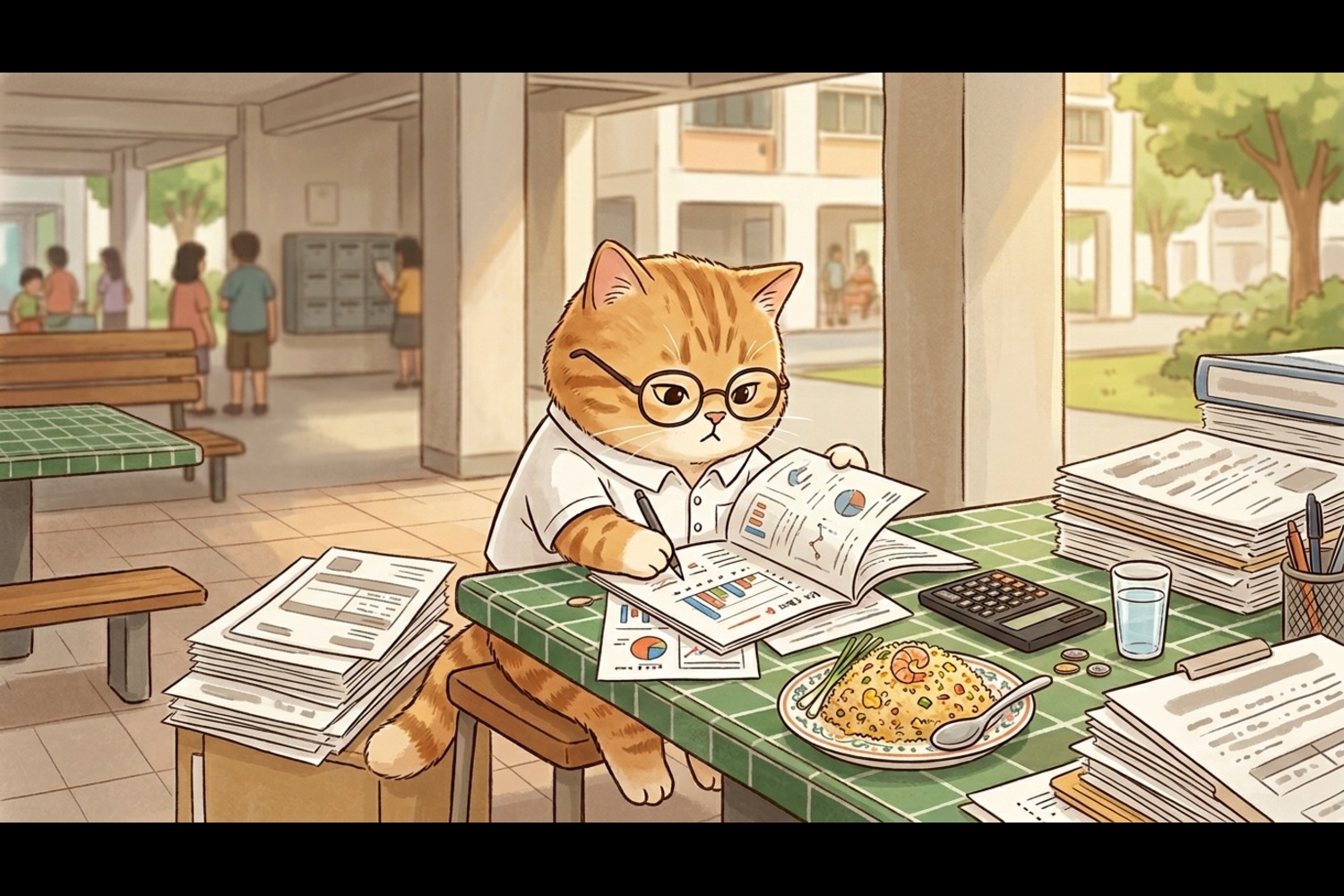
SERS Compensation & CPF Accrued Interest: How the Money Actually Flows
Saw this question come up recently in one of the SERS forums and it brought back memories of our own appointment at HDB back in May 2022. How exactly does HDB pay the SERS compensation — and what happens to the CPF accrued interest from the old housing loan? It is one of those things that feels crystal clear when the SERS Journey officer walks you through it at the appointment, then slowly turns fuzzy a few years later. Since we are all now in the home stretch before Pine Ville @ AMK key collection in Q2 2027, let me do a proper write-up on how the money actually flows, drawing from our own experience at Blocks 562-565 and official HDB/CPF documentation.
How HDB Pays the SERS Compensation
The compensation is not paid out as a cash cheque into your bank account the way some of us initially imagined. Instead, it all happens at a single point: key collection day. Everything is consolidated into one settlement — you sign the lease, make the final payment (or receive the surplus), and collect the keys, all in the same appointment.
According to HDB’s official SERS financing documentation, the compensation flows in this general sequence at key collection:
How the compensation flows at key collection:
- Step 1 — CPF refund first: Any CPF principal + accrued interest owed from the old flat’s housing loan is refunded back into your CPF Ordinary Account (OA).
- Step 2 — Outstanding loan settled: Any remaining housing loan on the old flat is discharged from the compensation.
- Step 3 — New flat purchase: The balance compensation, together with your CPF OA savings, is applied toward the purchase price of the replacement flat.
- Step 4 — Cash surplus or top-up: If compensation exceeds the new flat price, you receive the difference. If there is a shortfall, you top up the difference in cash or CPF.
This is exactly what happened at our HDB appointment — I wrote about it in SERS Connect Appointment at HDB. When Mrs. Meow (my better half, and significantly less distracted by void deck pigeons than I am) and I sat down with our SERS Journey officer in May 2022, she accessed our CPF, estimated the new flat cost by floor and orientation, and worked out the top-up or surplus figure right there on the spot. The actual money only changes hands at key collection years later, but we walked out of that appointment already knowing what to expect financially.
In our case, the estimated payable amount for a 4-room unit on the highest floor was S$580,225. After deducting CPF savings and SERS compensation, we were still looking at a top-up of around S$190,000 — plus renovation on top of that. Those numbers were a bit of a gut punch at the time, but at least we knew early what we were dealing with. Residents who chose lower floors would have had different figures, of course.
What Happens to the CPF Accrued Interest?
This is the part most of us half-remember. Let me spell out the mechanism clearly.
When you used your CPF OA savings to pay for your old HDB flat — whether for the down payment or monthly loan instalments — the CPF Board tracks not just the principal amount withdrawn, but also the accrued interest: the interest that money would have earned had it remained in your CPF OA. As of current rates, CPF OA earns 2.5% per annum, compounded yearly.
CPF rules require that upon disposal of the property — whether through open market sale, transfer, or in our case, SERS acquisition by HDB — both the CPF principal withdrawn and the accrued interest must be refunded back to your CPF OA. This is not a penalty. Think of it as CPF restoring your retirement savings to where they would have been had you never drawn on them for housing.
A simplified illustration of how accrued interest works:
- You withdrew $200,000 from CPF OA over the years to pay for your old flat.
- Over 20 years at 2.5% p.a. compounded, the accrued interest might amount to roughly $80,000–$100,000 (actual amount depends on timing and amounts of each withdrawal).
- When HDB pays out the SERS compensation, approximately $280,000–$300,000 (principal + accrued interest) goes back into your CPF OA, not to you directly in cash.
- You can then use those CPF OA funds toward the replacement flat purchase.
You can verify your exact CPF principal withdrawn and accrued interest at any time via the CPF portal under “My Statement” → Section C (Home Ownership), or through the CPF Home Ownership dashboard. The accrued interest figure there is the amount that will be refunded to your OA when the property transaction is completed.
Does the Accrued Interest Go Back Into CPF, or Is It Paid in Cash?
It goes back into CPF OA — not into your bank account. This is a common source of confusion. The money does not disappear, nor does it go to HDB. It is returned to your CPF OA, where you can use it to fund the replacement flat purchase.
For residents aged 55 and above, the picture is slightly different. According to HDB’s official information for senior SERS flat owners, some of the CPF refund may be channelled to meet the Full Retirement Sum in the Retirement Account (RA) before any balance is retained in OA or paid out in cash. HDB notes it will make the CPF refund before key collection — and if the resident needs those refunded CPF funds to buy the new flat, HDB can coordinate with CPF Board to leave the balance housing refunds in the OA for that purpose.
If you are aged 55 and above at time of SERS key collection:
- The CPF refund (principal + accrued interest) will first be used to meet your Full Retirement Sum in your RA, if that sum is not yet met.
- Remaining CPF refund balance stays in OA (for housing use) or may be paid out in cash.
- HDB will coordinate with CPF Board on your behalf to ensure funds are available for the replacement flat purchase.
- Generally, RA savings cannot be used for housing — they are ring-fenced for retirement.
The “Lump Sum at Key Collection” Advantage — and One Thing to Watch
One thing I appreciate about the SERS process compared to the standard BTO journey is that we do not make any payment until key collection day. I covered this in detail in my SERS vs BTO process comparison — BTO buyers have to fork out significant sums at their 2nd appointment, months before the flat is even ready, while we SERS residents settle everything in one go at key collection.
The flip side worth noting: our compensation amount was locked in at the 2022 SERS announcement date. Whether property prices went up or down between 2022 and 2027 does not change our compensation figure. That cut both ways depending on timing, but at least it is predictable. What does keep ticking in the background is the CPF accrued interest — it continues to accumulate on your CPF statement until the transaction is formally settled at key collection. So the refund amount going back into your OA in 2027 will be slightly higher than what your CPF dashboard shows today.
What If There Is a Cash Surplus After Everything?
If your compensation (after CPF refund and housing loan discharge) exceeds the price of the replacement flat, you get to keep the difference. According to HDB’s financing rules, SERS residents may retain half of the balance compensation or the advance payment amount, whichever is higher, subject to a minimum retention sum of $1,000. Up to $35,000 of balance compensation can also be advanced at key collection specifically for renovation — useful given how renovation costs have climbed.
Summary: The Flow at a Glance
| Question | Answer |
|---|---|
| When is compensation paid? | At key collection — one single consolidated settlement |
| Is it paid in cash to your bank? | Not directly. It is applied to the new flat purchase first; surplus (if any) may be paid in cash |
| What happens to CPF principal used for old flat? | Refunded back into your CPF OA |
| What happens to CPF accrued interest? | Also refunded back into your CPF OA — not lost, not paid to HDB |
| Can I use the refunded CPF for the new flat? | Yes. CPF OA balance (including refunded amounts) can be used toward the replacement flat |
| Different rules if aged 55+? | Yes. Refund may first top up Retirement Account to Full Retirement Sum before remaining funds go to OA or cash |
With Pine Ville @ AMK key collection now roughly two years away, it is worth logging into your CPF portal and pulling up the Home Ownership dashboard to check your current CPF principal withdrawn and accrued interest figures. That gives you a clearer picture of what will flow back into your OA at key collection, and how much of it you can put toward the replacement flat. If you want to look further ahead at your overall CPF retirement trajectory, I built a tool for that — HuatMyCPF — which is free to use and does not require any sign-up.
Sources: HDB SERS Financing a New Flat; HDB Information for Senior SERS Flat Owners; CPF Board — Refund When Selling or Transferring Property. This article is based on publicly available official documentation and my personal SERS experience as a Blocks 562-565 AMK Ave 3 resident. It does not constitute financial advice.
Disclaimer: This blog is maintained by a cat who likes fried rice and occasionally gets distracted by void deck pigeons mid-sentence. These distractions are logged as ‘field research interruptions’ rather than ‘inability to focus.’ Twenty years of void deck observation have provided unique insights into community transitions, though admittedly most of that time was spent napping. The fried rice thing is just a personal preference and completely irrelevant to SERS documentation.